


China's Contruction Tech Revolution
- ASIA INSPIRE
- Feb 16
- 5 min read

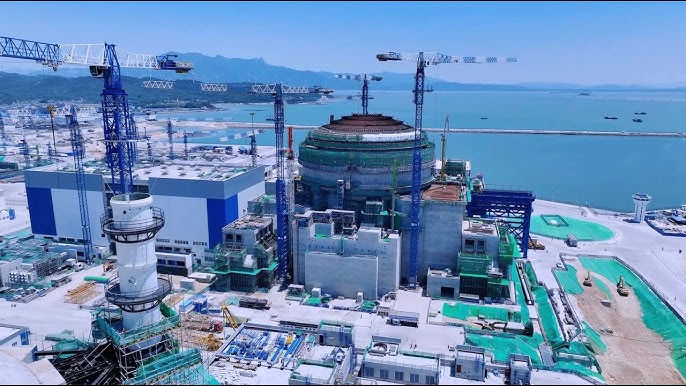
On a clear morning in Shenzhen, the construction site looks familiar at first glance: cranes swing overhead, concrete trucks queue at the gate, and workers in hard hats move with practiced urgency. Then you notice what’s missing.
The loudest tasks rebar tying, repetitive welding, even portions of finishing work are increasingly handled by machines that don’t tire, don’t take breaks, and don’t improvise. China’s construction industry, long defined by speed and scale, is entering a new phase: one where robotics and green materials are becoming as central to the job as steel and cement.

This shift isn’t a futuristic side project. It’s a pragmatic response to the pressures facing the world’s largest building market: rising labor costs, tighter safety expectations, the need for consistent quality, and the climate imperative to reduce carbon in one of the most emissions-intensive sectors on earth. The result is a construction ecosystem that is rapidly industrializing moving work from open air sites into controlled environments, and replacing manual repetition with automated precision.
The Robot Workforce Arrives
Construction has always been a difficult industry to automate. Every site is different, weather is unpredictable, and the work is often unstructured. But China’s approach has been to target the tasks that are most repeatable and most dangerous then scale from there.
Rebar-tying robots, for example, are designed for the kind of repetitive motion that strains human bodies over long shifts. Welding robots, already common in factories, are being adapted for structural steel work where consistent seams matter. Painting and spraying robots reduce exposure to fumes and improve uniformity. Floor-laying and polishing machines bring factory-like consistency to finishing stages that traditionally depend on craftsmanship and time.
Drones and robotic total stations less glamorous but arguably more transformative are now routine on many large projects. They scan sites, track progress, and generate high-resolution models that help teams catch errors early. In a country where timelines can be aggressive and projects massive, the value of early detection is hard to overstate: a misalignment caught in a scan is cheaper than a rework discovered after installation.
Robotics also changes the culture of safety. Machines can take on high-risk work at height, in confined spaces, or near heavy loads. That doesn’t eliminate risk, but it shifts it—reducing exposure for workers and creating new roles focused on supervision, maintenance, and systems operation.
From Site to Factory: The Industrial Logic

China’s most effective construction automation often happens off-site. Prefabrication and modular construction where building components are manufactured in factories and assembled on location create the controlled conditions robots need. Walls, bathroom pods, façade panels, and MEP (mechanical, electrical, plumbing) modules can be produced with tighter tolerances, less waste, and fewer weather delays.
This factory logic is also a bridge between robotics and sustainability. When components are manufactured precisely, material use becomes more efficient. Waste drops. Quality improves. And because assembly is faster, sites run cleaner and quieter an increasingly important factor in dense urban areas.
The broader implication is that construction begins to resemble advanced manufacturing: standardized processes, digital tracking, and automation that scales. China’s advantage is not just technological capability, but the ability to deploy it across large volumes of projects housing, infrastructure, industrial parks, and public buildings creating a feedback loop of learning and refinement.
Green Materials: The New Competitive Edge

If robotics is changing how buildings are made, green materials are changing what they’re made of. The construction sector’s carbon footprint is dominated by cement and steel, and China being the world’s largest producer and consumer of both sits at the center of the global decarbonization challenge.
One of the most immediate levers is low-carbon concrete. This includes mixes that reduce clinker content (the most carbon-intensive part of cement) by using supplementary cementitious materials such as fly ash, slag, and other industrial byproducts. The chemistry is complex, and performance must be carefully validated, but the direction is clear: the industry is learning to build with less embodied carbon without compromising strength.
Recycled aggregates are also gaining traction, especially as demolition waste becomes a resource rather than a disposal problem. Turning old concrete into new building material is not a perfect loop quality control matters, and not every application is suitable but it’s a meaningful step toward circular construction.
Then there’s the rise of engineered timber and hybrid systems, where wood is used alongside steel and concrete to reduce carbon and speed up assembly. While timber’s role varies by region and regulation, the broader trend is toward material diversification: using the right material for the right job, with carbon accounting increasingly part of the decision.
Insulation and façade materials are evolving too. High-performance glazing, improved thermal breaks, and advanced insulation reduce operational energy use critical in a country where urban buildings must handle both hot summers and cold winters. Green materials aren’t only about embodied carbon; they’re about the lifetime energy profile of the building.
When Robotics Meets Sustainability
The most interesting developments happen where robotics and green materials intersect. Automated systems can optimize material placement, reduce over-ordering, and improve installation accuracy small gains that add up across large projects. Precision matters when you’re trying to minimize waste, ensure airtightness, or meet strict performance targets.
Robots also enable new construction methods. 3D printing of concrete components, for instance, can reduce formwork waste and allow complex geometries that use material more efficiently. It’s still an emerging field, but China’s willingness to pilot at scale makes it a key testing ground.
Digital tools often paired with automation support sustainability by making carbon measurable. When a project team can track quantities, suppliers, and material specifications in a unified model, it becomes easier to choose lower-carbon options and verify outcomes. In that sense, robotics is not just a labor story; it’s a data story.
The Road Ahead
China’s construction technology revolution is not without friction. Robots require upfront investment, skilled operators, and maintenance ecosystems. Green materials require standards, testing, and supply chains that can deliver consistent quality. And the industry must manage a workforce transition moving from manual labor to technical roles without leaving people behind.
But the trajectory is unmistakable. Construction in China is becoming faster, cleaner, and more industrialized driven by the twin forces of automation and decarbonization. The building site of the near future may still have cranes and concrete, but it will also have robots scanning, welding, and assembling; materials engineered for lower carbon; and a digital backbone that treats sustainability as a measurable performance metric, not a marketing slogan.
In a world racing to build and rebuild more responsibly, China’s experiment matters. Not because it offers a single blueprint, but because it shows what happens when scale meets urgency, and when the tools of advanced manufacturing are brought to the oldest human project of all: making places to live, work, and move.


Comments